
Text
Milan Stefanovic
Insights
Workplace design, UX.
Over the past few years, organizations around the world have adopted hybrid work. The idea seemed simple: combine remote work with time in the office and offer employees flexibility.
Yet many workplaces now feel strangely disconnected from how people actually work.
The problem rarely lies in hybrid work itself. The problem lies in the assumption that existing offices can support it without deeper reconsideration.
Most offices were designed for a different rhythm of work, one where people arrived at the same time, worked primarily at individual desks, and used meeting rooms occasionally. Hybrid work has disrupted that rhythm.
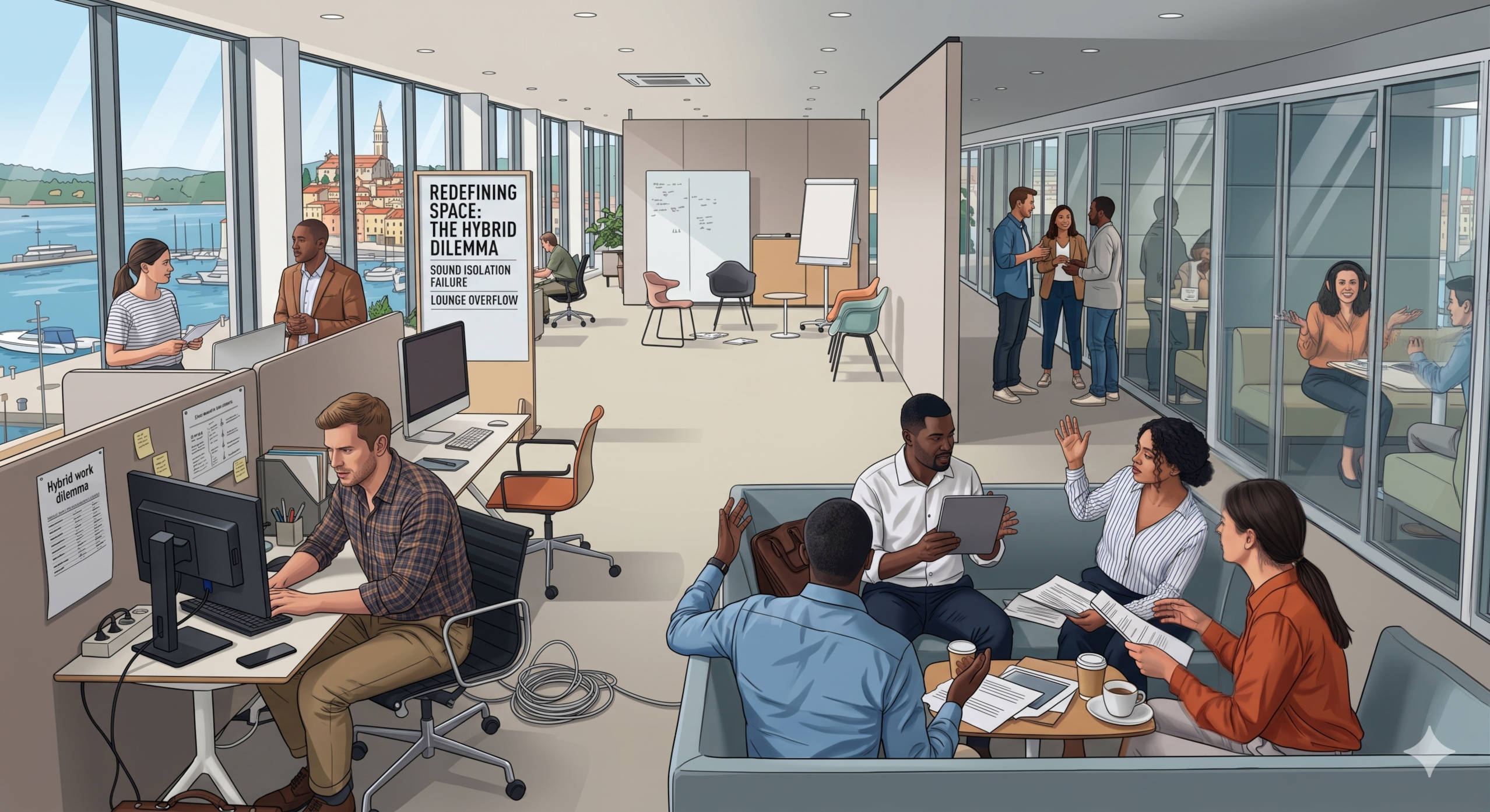
Today, people often come to the office for very specific reasons:
to collaborate, to learn from colleagues, to reconnect with teams, or to focus away from home. But when workplaces remain structured around assigned desks and traditional layouts, the office struggles to support these activities.
As a result, employees may arrive only to discover that the environment offers little advantage over working remotely.
Hybrid work does not simply change where work happens.
It changes why people come together in the first place.
Understanding those reasons requires careful observation of everyday behavior, how teams
collaborate, when people choose to come in, and what environments support their work.
Without this understanding, organizations often redesign workplaces based on expectations rather than reality. Hybrid workplaces succeed when they reflect how people actually work today, not how work once looked in the past.